 Skip to content
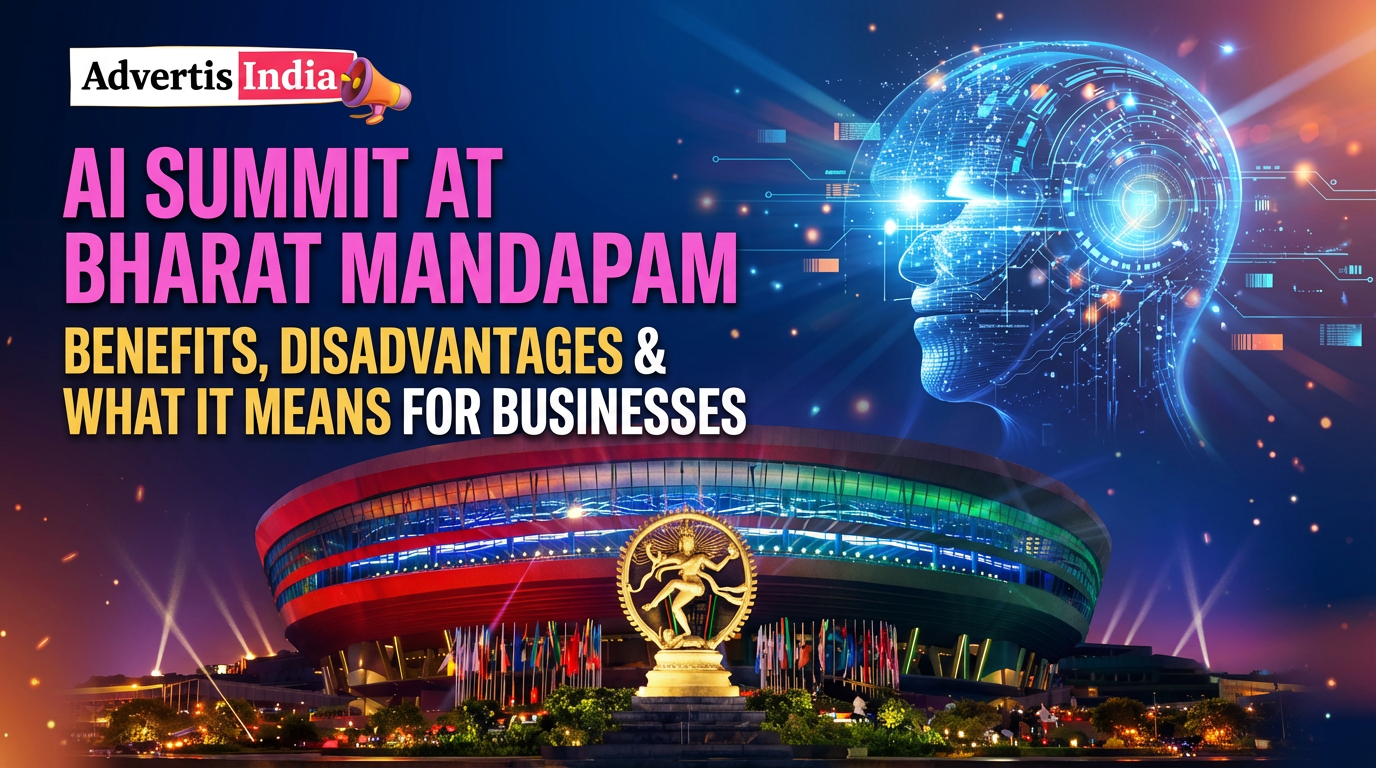
AI Is No Longer a Concept—It’s a Competitive Business Weapon
Introduction: AI Summit Has Shifted from Theory to Business Reality
With the recent AI Summit hosted at Bharat Mandapam, one message stands unmistakably clear: Artificial Intelligence is no longer a future-facing idea. It is actively reshaping how businesses operate, compete, and grow.
When policymakers, global technology leaders, innovators, and enterprises gather to discuss AI under one roof, it signals more than technological curiosity—it reflects economic transformation. AI is now central to governance, digital infrastructure, business strategy, and marketing performance.
This naturally raises an important question:
Does AI only bring advantages to businesses, or are there risks involved?
Understanding both sides of AI adoption is essential for organizations seeking sustainable growth rather than reactive experimentation.
What Is the AI Summit at Bharat Mandapam?

The AI Summit discussions at Bharat Mandapam represent a broader national emphasis on digital transformation and AI-driven innovation. Such summits typically focus on:
- Artificial Intelligence research and innovation
- Business transformation through AI
- Policy frameworks and governance models
- Startup ecosystem acceleration
- Cross-industry AI applications
These forums accelerate AI acceptance across industries, including healthcare, finance, education, retail, logistics, manufacturing, and digital marketing.
Hosting such initiatives at a global convention hub reflects the seriousness of AI within India’s digital growth strategy.
Why AI Adoption Is Accelerating Across Industries
AI adoption is not driven by trend-following—it is driven by business pressure. Organizations face three persistent challenges:
- Intensifying market competition
- Rising customer expectations
- The need for faster decision-making
AI enables businesses to process large datasets, automate workflows, predict consumer behavior, and optimize operational efficiency at scale.
However, adoption without strategic clarity often leads to wasted investment and operational friction.
What Are the Core Benefits of AI Summit for Businesses?
AI extends beyond automation. Its true value lies in intelligence, efficiency, and scalability.
Key Benefits of AI Adoption
- Faster data analysis and decision-making
- Predictive customer behavior insights
- Cost reduction via automation
- Enhanced marketing personalization
- Improved operational efficiency
- Real-time performance optimization
- Smarter audience targeting
- Elevated customer experience
Properly implemented AI reduces manual errors, accelerates response cycles, and improves business precision.
How AI Is Transforming Digital Marketing
Digital marketing is among the most aggressively transformed domains.
AI-Driven Marketing Capabilities
- Predictive lead scoring
- Automated ad bidding optimization
- Intelligent audience segmentation
- Hyper-personalized email campaigns
- Content performance prediction
- Real-time campaign recalibration
Businesses ignoring AI integration risk falling behind competitors using data-driven optimization systems.
What Are the Disadvantages and Risks of AI?
Uncritical enthusiasm for AI can be dangerous. Businesses must evaluate potential limitations.
Common Challenges of AI Adoption
- High initial implementation costs
- Data privacy and security concerns
- Over-dependence on automation
- Workforce displacement concerns
- Algorithmic bias and ethical issues
- Loss of human creativity when misused
- Complex technical integration
AI is a force multiplier—poor strategy magnifies failure rather than success.
Industries Experiencing Strong AI Impact
| Industry | AI Impact |
| Healthcare | Predictive diagnostics & automation |
| Finance | Fraud detection & risk analysis |
| E-commerce | Personalized recommendations |
| Education | Adaptive learning systems |
| Real Estate | Smart lead qualification |
| Digital Marketing | Predictive targeting & ROI optimization |
Organizations leveraging AI intelligently often achieve disproportionate competitive advantage.
Which Businesses Should Approach AI Carefully?
Not every company is ready for AI integration.
Caution is warranted when:
- Data tracking systems are weak
- Digital infrastructure is fragmented
- Strategic clarity is lacking
- Operations remain heavily manual
AI amplifies both strengths and weaknesses. Foundational gaps become immediately visible.
When Should AI Be Implemented?
AI delivers maximum value under the right conditions:
- Consistent flow of user or customer data
- Active marketing and acquisition channels
- Conversion tracking systems in place
- Growth scalability objectives defined
AI without data infrastructure typically produces negligible returns.
The Role of Marketing in the AI-Driven Economy
While AI enhances optimization and automation, it cannot replace:
- Brand storytelling
- Strategic positioning
- Conversion psychology
- Authority-driven SEO frameworks
Technology improves execution, but differentiation remains a human-driven discipline.
How Advertis India Helps Businesses Leverage AI
AI tools alone do not produce growth—structured integration does.
Advertis India applies AI within a strategic marketing framework:
- Strategic AI marketing integration
- AI-powered SEO analytics
- Data-driven ad optimization
- Smart audience targeting
- Behavioral retargeting systems
- Conversion funnel automation
- Performance tracking & ROI analysis
This approach ensures AI supports measurable business outcomes rather than experimental usage.
Outcomes of Smart AI + Marketing Alignment
Businesses aligning AI with marketing strategy typically observe:
- Higher advertising ROI
- Improved lead quality
- Faster campaign optimization
- Reduced customer acquisition costs
- Stronger brand positioning
- Predictable growth models
Failure to integrate strategically often results in competitive decline.
Opportunities Created by the AI Summit Momentum
Events like the Bharat Mandapam summit catalyze:
- Greater AI awareness
- Faster adoption cycles
- Increased digital competition
- Innovation-driven business models
As AI adoption rises, visibility and positioning become critical survival factors.
FAQs – AI, Business, and Marketing Impact
Q1: What does the AI Summit signal for India’s business landscape?
It reflects accelerating digital transformation and AI-driven innovation across sectors.
Q2: Can AI benefit small businesses?
Yes—provided digital foundations and data systems are properly structured.
Q3: Will AI replace digital marketing agencies?
No. AI improves efficiency but cannot substitute strategic thinking and creative positioning.
Q4: What are the major risks of AI adoption?
Data privacy concerns, integration challenges, and over-automation risks dominate.
Q5: How should companies prepare for AI integration?
Strengthen analytics infrastructure, tracking systems, and marketing strategy first.
Q6: Does AI directly improve SEO rankings?
AI assists optimization, but high-quality content and authority signals remain decisive.
Q7: Should every business invest in AI immediately?
No. Readiness assessment is essential before capital allocation.
Q8: How does AI influence consumer trust?
Balanced human-AI interaction strengthens trust; excessive automation may weaken it.
Conclusion: AI Is a Tool—Strategy Is the Advantage
The AI Summit at Bharat Mandapam underscores a fundamental shift: AI is redefining how businesses operate and compete. Yet technology alone does not guarantee growth.
Organizations combining AI capabilities with a robust marketing strategy and strong digital positioning are the ones that dominate markets.
Businesses seeking structured AI integration, stronger visibility, and sustainable growth trajectories require more than tools—they require strategic direction.
Advertis India positions itself as that strategic growth partner.
AI may be accelerating change—the real question is whether your marketing infrastructure is ready for it.

